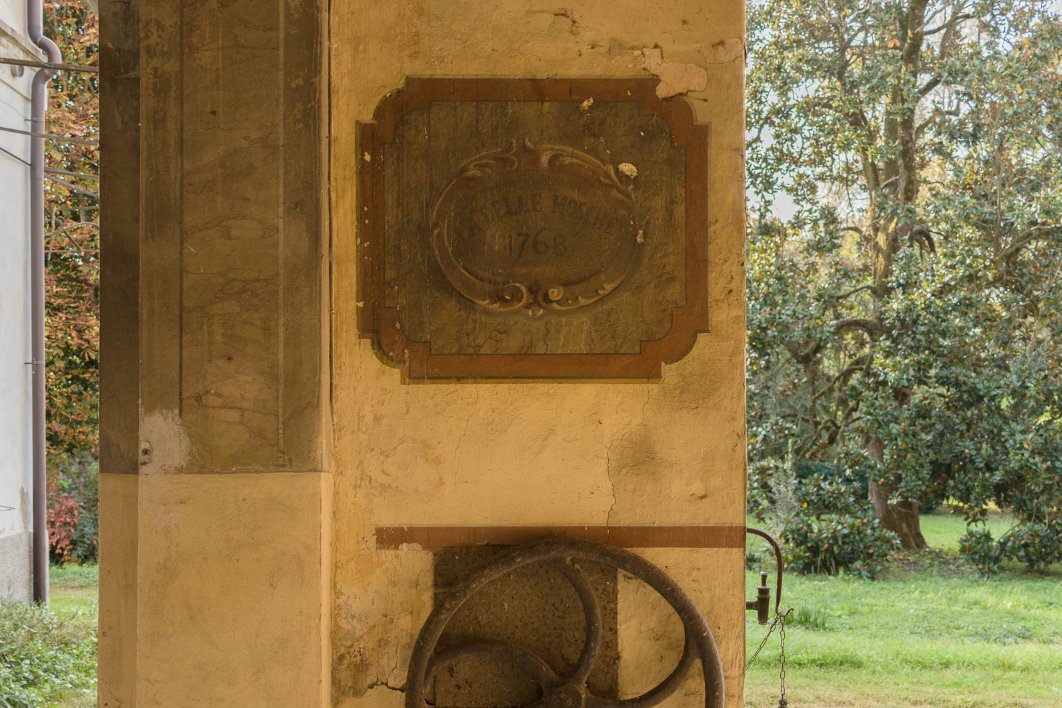
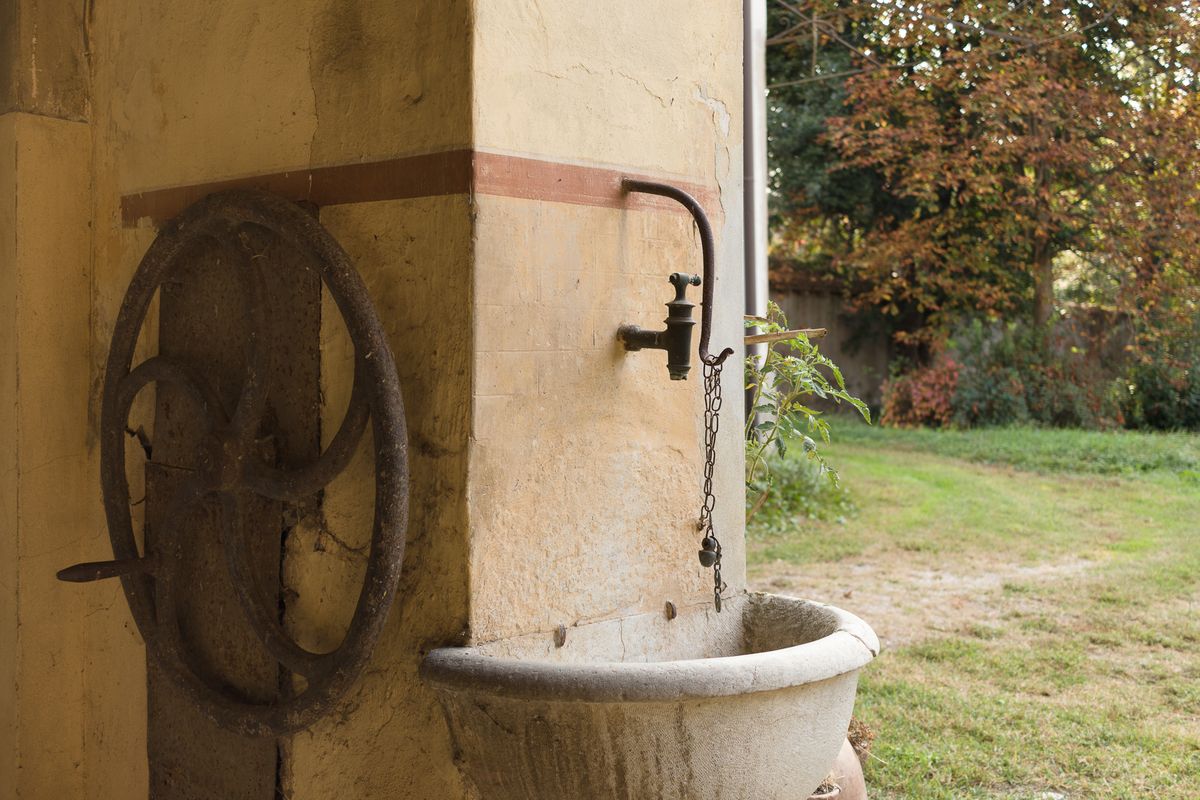
"Yes, it is an ancient story". The voice of my mother Bianca Maria was that of a strong woman. In front of an astonished schoolmate of mine, when I was perhaps still in middle school, stood that date – 1768 – stamped in a painted frame in shades of ochre and burgundy, right above the "pump" that, until the Seventies, was operated with a mechanical wheel to draw water up from the well. It was, and is, a sort of relic we loved to play with and beside which a small electric motor, barely hidden, had brought modernity and the water from the aquifer beneath the foundations. But that date… Mother told us that when the house had been largely renovated in the Fifties, that date had been suggested by my father Gian Pietro, who died prematurely in a plane crash in 1959, and who had devoted much of his little free time (he was managing director of a large American publishing house) to refurbishing what had once been a hayloft between the old manor house and the caretakers' dwelling. A thousand square metres or so recovered from a shelter that served to protect from the rain the hay of the fields surrounding the property. But it was hiding something else.
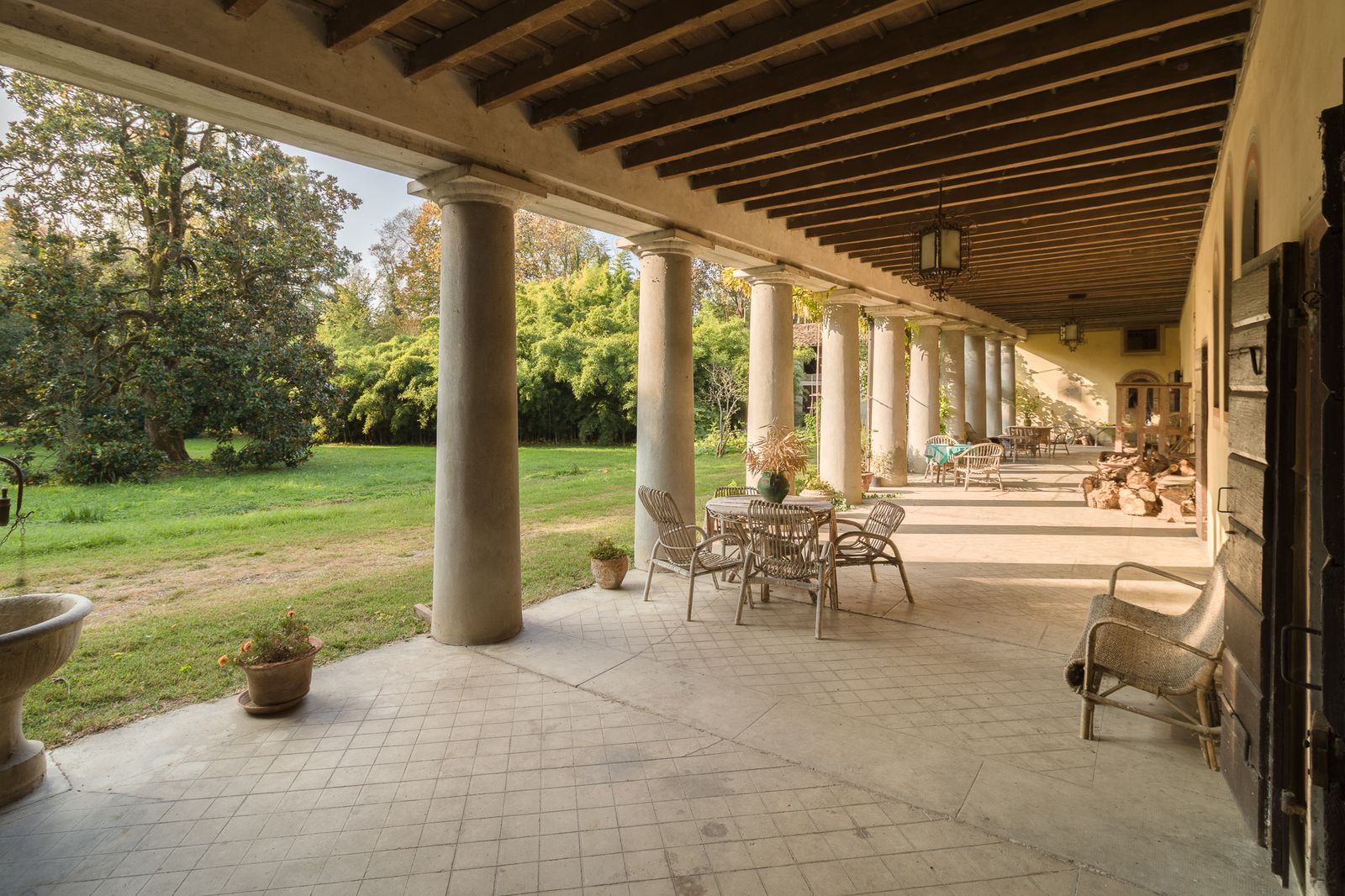
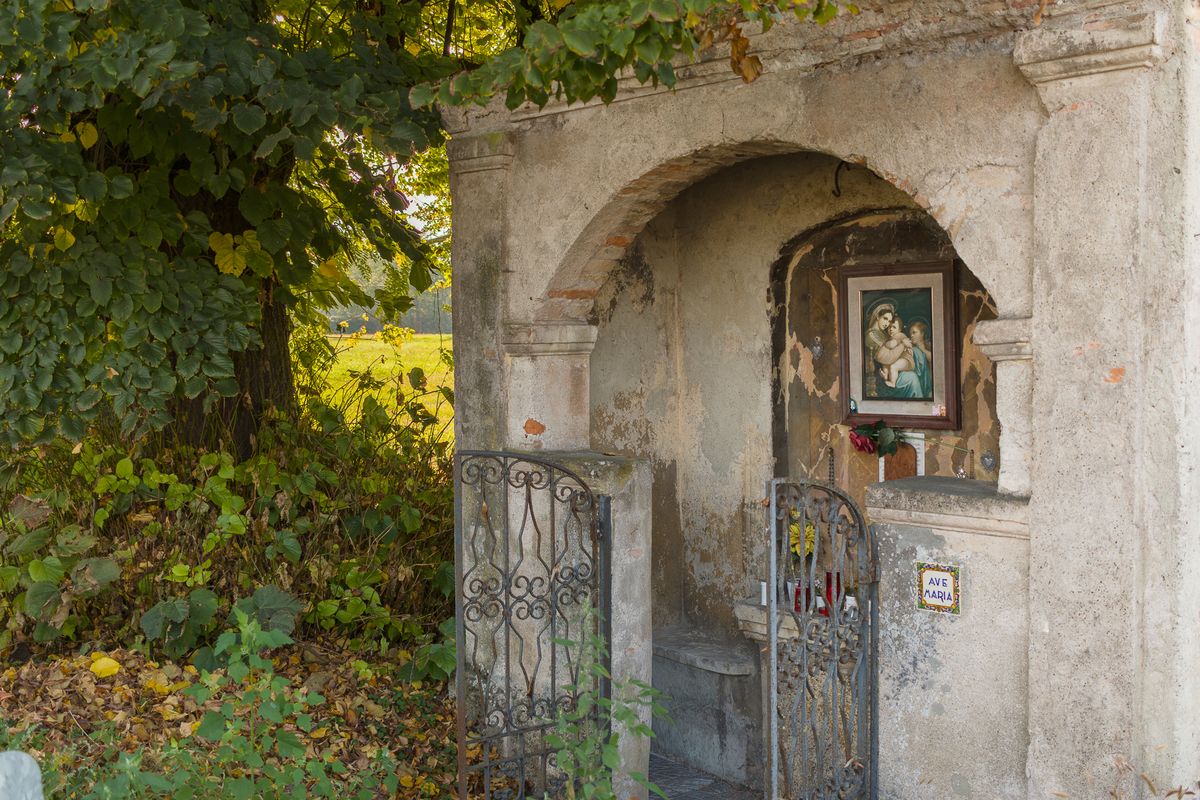
In the Nineties, when it became necessary to work on the great wooden beams that supported the portico, a very different origin came to light. The masons and the foreman who had to replace the massive oak beams noticed that, as they chipped away part of the plaster on the inner façade of the eastern side, a brick vault emerged, repeating itself every two columns of the portico. So, long before the hayloft and the stables that Dad had transformed into the present complex, in which three apartments were created, there must have been a vaulted ceiling, and therefore some of the columns, which bore no weight, had been added later. That vault, like the mechanical pump or the votive chapel at the top of the access avenue, belongs to a piece of History that is lost in the centuries and of which little trace remains: "...a lighter structure – writes Giorgio Zucchelli – transformed, at a much later date, into a building with a rustic function. The original structure might suggest a conventual origin (fifteenth century?), also confirmed by the vaulted cellars in the central body of the complex" and which extended beneath the layout of the building and of the garden through large spaces and tunnels, now largely walled up. Researching the sources is not easy. Here and there, however, one finds mentions of ancient ecclesiastical building works, as recalled by a piece of research from the University of Pavia: "… in 1703, finally, in the locality of Ca' delle Mosche, the oratory of Saint Francis of Assisi was rebuilt"*. Rebuilt… oratory, prayers, monks of an ancient convent… who perhaps wandered under a cloister to go and pray in a little church, the trace of which can still be found in a part of the old farmyard of the farmhouse, where a small bell tower rises above what in time must have become a rural dwelling.
Even on the origin of the name (Ca' delle Mosche), quotations and oral history intersect without giving an answer. It seems there was an agricultural plot called Mosche that appears in a few citations. And then those Mosca gentlemen, Venetians, who are said to have lived in the area when Crema was under the Serenissima. On the more recent History, perhaps the most reliable compendium is the one devoted to Ca' delle Mosche by Giorgio Zucchelli in his monumental "Le ville storiche del cremasco". His History, in some respects a chronicle based on oral sources, goes back to the time when the house belonged to the Rossi Martini (a branch of the family known for bitter and vermouth) who, together with the Zurla marquises or the Sanseverino counts, shared lands, palaces and farming families among the rich landed estates of this lush slice of the Po Valley. It is thought that the present structure of the whole complex is due to two Martini brothers who wanted to make it a house of representation in the first half of the 1800s. "The project was ambitious – writes Zucchelli – but the works were not completed… the new façade was raised… but only as a sort of screen to which the interior rooms were to be attached in later works". The Martini, however, failed in their enterprise of building a sort of palace in an "eclectic" and vaguely Venetian style with "all the openings in the shape of a classical mullioned window with Doric columns and half-columns, framed, with lintels and sills" with "the portal of the present entrance ...(with) on the right, a long portico". Today you can still see the traces of a gigantic original design that wanted the manor house much larger, just as you can see the extensions, on the eastern side, designed in keeping with the openings of the façade but built in the 1950s.
Zecchini and ducats had perhaps run out for the Mosca and then for the Martini, who sold a property that was to return to a branch of the family only with Gerolamo Rossi-Martini – who acquired it in 1897 – and whose coat of arms can be recognised, a goat on a blue field surmounted by three six-pointed stars, painted on a ceiling of the Villa. In 1861, with the Unification of Italy, the lira had meanwhile been born and a new economy began to make its way, while that part of the élite that lived on landed income, and which only in a few cases had been able to turn it into industrial investment, was disintegrating. The countryside changes, a richer and more cultured peasant class grows and, in the cities, an urban bourgeoisie that acquires pieces of agricultural property that the landed nobility begins to sell off, along with its palaces, in order to maintain, albeit on a reduced scale, the splendour of former times.
Among the latter is a journalist from Crema, Tullio Giordana (1887-1950), born into a family that not only had no great means (his mother, Elvira Carniti, ran a tobacconist's, his father Pietro was a lieutenant of the mounted Carabinieri who would be stationed at Crema and Castelleone), but which left him an orphan, with his sister Cloe, at a very young age. The wealthy Samarani relatives would adopt them and have them educated. Very young, Tullio took part with Ricciotti Garibaldi in the Greco-Turkish war of 1897, became a journalist and, during a trial in Genoa, met his future wife, Clelia Bertollo, who came from the rich Ligurian industrial bourgeoisie of textiles (the famous Blu Genova, better known as blue jeans). Clelia is the victim of a conspiracy: it turns out that her stepfather was trying to eliminate all the Bertollo children from the first marriage in order to seize the inheritance: he had allegedly eliminated a brother and a sister and was now poisoning her too. Discovered in time, the stepfather was put on trial (but would not be convicted) just as the young reporter from Crema was beginning his career. Clelia and Tullio met in court and fell in love. They married in Sanremo on 9 December 1901. It was she who bought Ca' delle Mosche and, later, financed his publishing house. Journalism – or rather newspapers, since my grandfather directed several – would take them to live in Rome, but the "home" that would always remain in their hearts was Ca' delle Mosche or Villa Giordana, as Zucchelli calls it. My grandfather stood for election in the ranks of the Italian Radical Party (ancestor of the Liberal Party) while grandmother Clelia devoted herself to the villa where, legend has it, she kept her horse in the dining room to keep her company when my grandfather went off to war. And yes, because Tullio had a passion for war: a journalistic passion that would later turn into the military art of the soldier, to the point of sending off to the East African campaign a former journalist who had defied Mussolini by accusing him of the Matteotti murder and who, for this, had lost his job and his newspaper.
During the twenty years of the Fascist regime, Clelia and Tullio, whose newspaper had been expropriated by the regime, divided their time between the Cremasco and Spoleto, in whose countryside they owned the estate of Colle Montano where, on 80 hectares, grandfather Tullio fought – as a farmer – his battle for grain, to which he even devoted a book (Oro in chicchi). But after the plough of Colle Montano and the sword of East Africa, another war loomed on the horizon, materialising within the great world conflict: the partisan one. Both he and his son Gian Pietro joined the Resistance without knowing of each other. It was in that context that my father Gian would meet the Americans – the liberators – and decide to work for them. My grandfather returned to journalism, but only for a short while. In 1950 a malarial fever caught in the swamps of Upper Volta struck him down. Clelia would follow him shortly afterwards. Colle Montano was sold, but not Ca' delle Mosche. Andrea Barbaglio, the tenant farmer who for years had run the 44 hectares surrounding the house, was decisive: "Don't sell the land and the Villa, here things can only gain in value. If you really must, let Colle Montano go, where two pertiche [a traditional unit of land area] are worth one of the Mosche's!".
Young Gian followed in Tullio's footsteps. He was a journalist, like him, and also a writer (as a very young man he published his experience at the Liceo Visconti in Rome), but now he felt the call of politics. He intended to stand as a candidate with the Christian Democrats and left for America to resign from Reader's Digest. The plane crash took him away at the age of 46. We were right here at the Mosche, my brother Marco Tullio and I, when the accident happened a few kilometres from Malpensa. We had just moved into the house that Mum and Dad had arranged precisely for us children. They would go to Rome, we would live in Crema. It is to Dad that we owe this wing of the house where styles are mixed up, where the modernity of marble-chip tiles fights with the old terracotta floors and where the ceilings are lowered to hide the beams that support the roof and to let the modern heating pipes through. It is here that Dad and Mum furnished a home with furniture that the nobility had sold to the "junk dealers" in that continuous passing from hand to hand – and from taste to taste – that proposes and proposes again, makes precious what yesterday was to be thrown away, proclaims antique what others call old. Or vintage what some consider simply "past". Dad's dream remained in the drawer and Mum chose Milan so that we could study; but Ca' delle Mosche remained for us too the "home". It is the place of our summers, when the farmhouse employed perhaps forty people. Cutting the wheat was a celebration and "spannocchiare" [husking the maize] a job for which the tenant farmer paid us a small tip, a little treasure for sweets and toy cars.
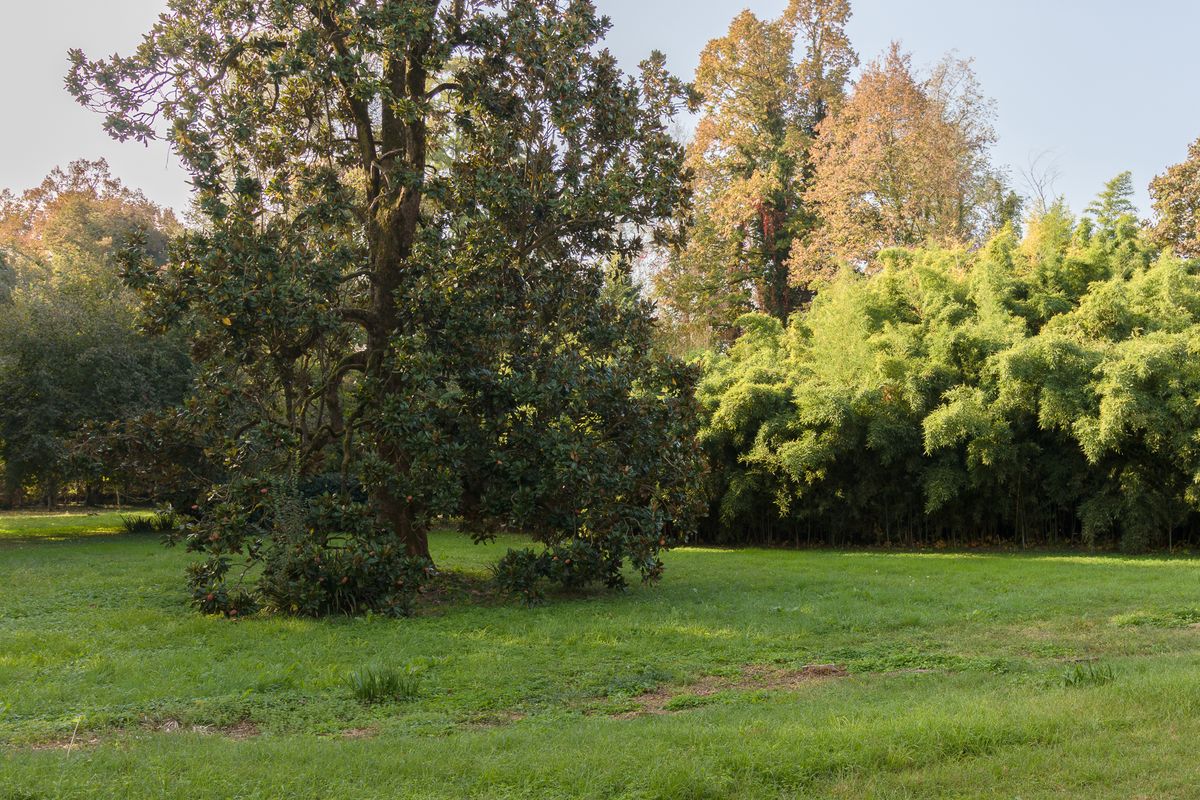
This house has gone on living in the minor History of a family that is also the memory of a greater History, within a piece of Italy, its changes and the many just little revolutions that brought thousands of peasant families out of poverty, out of minimal houses without running water or toilets, out of stories fascinating to the anthropologists of a peasant civilisation that warmed itself in the stables and welcomed industry as a blessing, as it turned peasants into workers "without that smell of the stable – one of them told me – that makes the girls run away". Within these walls, in the cycle of the recurring seasons, beneath the centuries-old trees of the avenue, we too have passed. My brother Franco, engineer and botanist, who left a woodland that is today an eight-hectare green lung donated to the Parco del Serio. My sister Barbara, who discovered how the stomach of the silkworm works and who went over our homework with us during the holidays. My brother Marco Tullio, now an established film director, who shot a piece of his first film right here, in the garden of Ca' delle Mosche, shared with his wife Caterina and with me. Finally me, Emanuele, the youngest, with my two children Malvina and Giovanni and my mother Alessandra. A journalist like grandfather and Dad, but not at all attracted by political candidacies. But stories, yes, those I have always liked: telling them, writing them, dissecting them. Many times I have done so at Ca' delle Mosche. So much so that I think that, hanging on a leaf or stuck to a piece of bark, some headline or short tale must have remained. Like this one.
Emanuele Giordana, Crema, November 2025
* Quoted in Le istituzioni storiche del territorio lombardo. Le istituzioni ecclesiastiche XIII-XX secolo [The historic institutions of the Lombard territory. Ecclesiastical institutions, 13th-20th century], Pavia, 2005.